Get Started Now About A Hidden Hack For SEO Dominance Today
Answer Engine Optimization (AEO): What It Is and Why You Need to Start Now
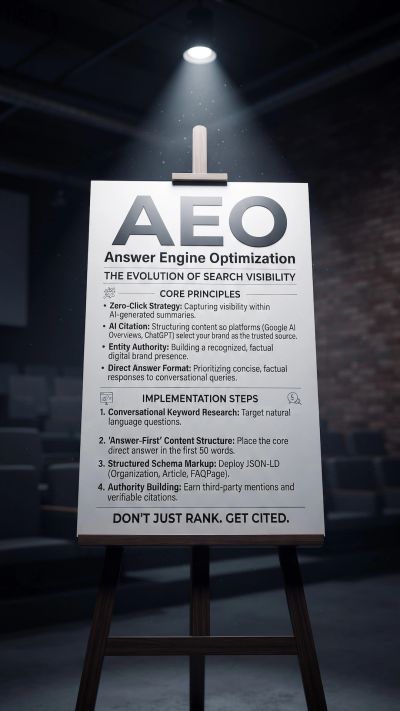
Answer Engine Optimization (AEO) is the practice of structuring, formatting, and verifying your website’s content so artificial intelligence platforms—such as Google AI Overviews, ChatGPT, Perplexity, and voice assistants—select and cite your brand as the direct answer to user queries. Starting AEO alongside your standard SEO protects your organic visibility as search shifts from blue links to instant, AI-generated answers.
In This Guide:
- 7 Reasons Why Starting AEO Now Is Essential for Your Website
- What Is Answer Engine Optimization (AEO)?
- How Popular Is AEO Becoming? (Verified Data & Trends)
- AEO vs. Standard SEO: How Do They Work Together?
- How to Implement AEO on Your Website Today
- Interactive AEO Readiness Checklist
- Frequently Asked Questions About AE
Check Your Website’s AEO Visibility
Join us and discover what we can do for you.
7 Reasons Why Starting AEO Now Is Essential for Your Website
Before Diving Into The Technical Mechanics
Here is a complete summary of why integrating Answer Engine Optimization into your existing SEO roadmap is one of the highest-leverage moves you can make for your digital presence:
- Consumer Search Behavior Has Permanently Shifted Toward Direct Answers: Over half of modern buyers now initiate product and vendor research inside AI chatbots rather than traditional search result pages, meaning brands absent from AI responses lose visibility before a customer ever reaches Google.
- Zero-Click Searches Are Eroding Traditional Click-Through Rates: When AI summaries appear at the top of search results, users click traditional organic links roughly half as often as they do on standard results pages, making citation inside the AI answer itself the new top-ranking position.
- AEO Builds Directly on Your Existing SEO Foundation: You do not need to abandon search engine optimization; Google’s official search documentation confirms that foundational SEO—crawlability, fast page speed, and helpful content—remains the core requirement for appearing in generative AI features.
- Early Adopters Capture Massive First-Mover Advantage: While a vast majority of marketing executives recognize that AEO will reshape digital strategy, industry surveys reveal that only a small fraction have actively implemented structured AEO workflows, leaving wide-open territory for early movers.
- AI Citations Drive Higher-Intent, Better-Qualified Traffic: Visitors who click through from an AI citation or search for your brand by name after seeing it recommended by an assistant arrive further down the buying funnel with stronger purchase intent.
- Smaller Domains Can Outrank Industry Giants Through Clarity: Unlike traditional rankings where domain authority often locks smaller websites out of page one, answer engines frequently cite mid-sized and niche websites that provide clearer, better-structured, and more direct answers.
- Enterprise Investment in AEO Is Accelerating Rapidly: With enterprise marketing leaders aggressively increasing their AI search budgets, waiting another year means competing against entrenched competitors whose brand entities are already deeply mapped into large language models.
What Is Answer Engine Optimization (AEO)?
Answer Engine Optimization (AEO) is the strategic process of optimizing your digital content, technical schema, and off-site brand authority so AI-driven answer engines can easily retrieve, verify, and synthesize your information into direct user responses.
In traditional search engine optimization, your primary goal is to earn a high placement on a list of ten blue links so a user clicks through to your webpage. In Answer Engine Optimization, the interface changes. Instead of presenting a list of webpages for the user to sift through, platforms like Google AI Overviews, ChatGPT, Perplexity, and voice assistants like Siri and Alexa read multiple sources, synthesize the facts, and deliver a single conversational answer—complete with inline source links or brand mentions.
Think of standard SEO as making sure your book is prominently displayed on the front shelf of a library. Think of AEO as making sure the librarian has read your book, trusts your expertise, and quotes your exact words whenever a visitor walks up to the desk with a question.
How Popular Is AEO Becoming? (Verified Data & Trends)
The adoption of AI-powered answer engines has transitioned from an experimental trend into a mainstream shift in how people discover information, research products, and make purchasing decisions.
Understanding the true data behind this shift helps clarify why treating AEO as optional is no longer viable for growth-focused websites:
Rapid User Adoption Across AI Search Platforms
According to Google’s search performance disclosures, AI Overviews has expanded to serve more than 2.5 billion monthly active users, while Google’s conversational AI Mode surpassed 1 billion monthly users within its first year of availability. Meanwhile, independent market tracking shows that standalone AI platforms like ChatGPT have reached hundreds of millions of monthly active users processing billions of queries every month.
The Rise of Zero-Click Behavior and CTR Shifts
As answer engines deliver immediate summaries on the results page, user click behavior has changed measurably. A browsing study by the Pew Research Center found that when an AI summary appeared at the top of a search page, users clicked a traditional organic result in only 8% of visits, compared to 15% when no AI summary was present. Similarly, large-scale keyword research from Ahrefs demonstrated that the presence of an AI Overview reduced the average click-through rate for the #1 organic ranking position by over 34% initially, widening to 58% in subsequent data tracking.
How Popular Is AEO Becoming? (Verified Data & Trends)
The adoption of AI-powered answer engines has transitioned from an experimental trend into a mainstream shift in how people discover information, research products, and make purchasing decisions.
Understanding the true data behind this shift helps clarify why treating AEO as optional is no longer viable for growth-focused websites:
The B2B and E-Commerce Discovery Shift
This shift is not limited to simple trivia or weather lookups; it directly impacts commercial revenue. According to G2’s B2B Buyer Behavior Report, 51% of B2B software buyers now begin their vendor research inside an AI chatbot rather than on a traditional search engine—a 22-percentage-point jump in just twelve months. Furthermore, the Gartner research forecast accurately anticipated the broad migration of traditional search queries toward virtual agents and generative interfaces.
The First-Mover Adoption Gap
Despite overwhelming evidence of changing user habits, most businesses have been slow to adapt. Industry research published by Conductor indicates that 94% of enterprise CMOs and digital leaders plan to increase their investment in AEO and generative search optimization. Yet a separate study by Acquia and Researchscape revealed that while 70% of marketing professionals believe AEO will significantly impact their strategy, only 20% have actually begun implementing it. That 50-point gap between awareness and execution represents a rare window of opportunity for websites that start optimizing today.
AEO vs. Standard SEO: How Do They Work Together?
AEO does not replace standard SEO; rather, AEO acts as an evolution built directly on top of your existing search engine optimization foundation.
In fact, as outlined in Google Search Central’s AI Optimization Guide, a webpage must first meet standard technical SEO requirements—such as being crawlable, indexable, and eligible for a search snippet—before Google’s generative AI features will consider surfacing it. However, once your technical baseline is solid, AEO requires subtle shifts in how you structure sentences, format data, and measure success.
Strategic Dimension: Standard SEO (Search Engine Optimization), AEO (Answer Engine Optimization).
Primary Objective: Rank in the top 10 blue links to win organic clicks. Be cited, quoted, or recommended inside AI-generated answers.
Content Structure: Long-form narratives designed to maximize page dwell time. "Inverted pyramid" blocks: direct 40–60 word answers first, followed by supporting detail.
Heading Strategy: Keyword-focused topic headers (e.g., "AEO Benefits"). Conversational, natural-language questions (e.g., "Why Is AEO Important?").
Formatting Preference: Paragraphs, images, and internal links. Bullet lists, numbered steps, comparison tables, and clear definitions.
Technical Emphasis: Crawlability, mobile speed, sitemaps, and canonical tags. All standard technical SEO plus rich JSON-LD Schema markup and entity consistency.
Core Success Metrics: Keyword rankings, organic sessions, and click-through rate (CTR). AI citation frequency, brand mention share of voice, AI referral traffic, and branded search lift.
How to Implement AEO on Your Website Today
To optimize your website for answer engines, restructure your high-value pages around explicit user questions, lead every section with a concise direct answer, implement structured schema markup, and build authoritative off-site brand mentions.
Here is the exact, step-by-step framework you can apply to your existing and upcoming content:
1. Research Conversational Questions, Not Just Short Keywords
Traditional keyword tools show you short phrases like "best CRM software." Answer engine users type or speak full, nuanced questions like "What is the best CRM software for a 15-person real estate team with automated follow-ups?" Mine your customer support tickets, sales call transcripts, Google’s "People Also Ask" boxes, and Reddit discussions to compile the exact natural-language questions your buyers ask.
2. Use the "Answer-First" Inverted Pyramid Format
Large language models are designed to extract clear, self-contained passages. According to an empirical study by Surfer, 38% of AI Overview citations come from the very first 100 words of a webpage. Immediately under every H1 and H2 question, write a crisp, factual 40-to-60-word summary that directly answers the question without fluff. Once you have delivered the direct answer, expand with nuance, examples, and deeper analysis.
3. Structure Data with Lists, Tables, and Clear Definitions
AI models parse structured formatting far more reliably than dense walls of text. Research analyzing over 400,000 AI Overviews found that 78% of generated answers contained either a bulleted or numbered list. Whenever you explain a multi-step workflow, use numbered lists; whenever you compare tools, pricing, or strategies, use clean HTML tables.
4. Deploy Comprehensive JSON-LD Schema Markup
Structured data acts as a translator that tells search engines and AI crawlers exactly what your content represents. Using standardized vocabulary from Schema.org, implement Organization, Article, FAQPage, HowTo, and Product schema across your core pages. While schema alone does not guarantee an AI citation, it eliminates ambiguity around your brand entity, pricing, authorship, and facts.
5. Build Off-Site Consensus and Entity Authority
Academic research from Princeton, Georgia Tech, and IIT Delhi (ACM KDD) demonstrated that incorporating credible citations, verifiable statistics, and authoritative quotations can boost content visibility in generative engines by up to 40%. Beyond your own website, answer engines cross-reference third-party validation. Earning mentions on reputable industry publications, YouTube tutorials, verified review platforms, and authentic community forums signals to AI models that your brand is a trusted consensus choice.
Interactive Engagement Module: Your 60-Second AEO Readiness Check
How ready is your website for AI search engines? Check every item that currently applies to your top 10 landing pages:
- [ ] Crawlability & Indexation: Your robots.txt allows search and AI crawlers to access your core educational and product pages, and your pages load in under 2.5 seconds.
- [ ] Question-Based H2s: Your main subheadings are phrased as natural questions your customers actually ask.
- [ ] 50-Word Direct Answers: Every major section opens with a clear, standalone 2-to-3 sentence answer before diving into background context.
- [ ] Validated Schema Markup: You have active Organization, Article, and FAQPage JSON-LD markup verified via Google’s Rich Results Test.
- [ ] Original Data & Citations: Your pages include specific statistics, original examples, and links to credible primary sources rather than generic AI-rewritten fluff.
Your Score:
- 4–5 Checked: You are ahead of 80% of competitors. Focus on tracking your AI citation share of voice and expanding off-site brand mentions.
- 2–3 Checked: You have a solid SEO base, but AI engines are likely summarizing your competitors instead of citing you. Start by reformatting your top 5 traffic pages using the Answer-First method.
- 0–1 Checked: Your content is largely invisible to generative search. Request a foundational SEO + AEO audit to fix technical blockers and schema gaps first.
Frequently Asked Questions About AEO
Does AEO mean traditional SEO is dead?
No—traditional SEO is not dead; it is the mandatory foundation that makes AEO possible. Google still commands roughly 90% of traditional search market share, and its AI Overviews rely heavily on Google’s core organic search index to retrieve and verify information. If your technical SEO is broken, answer engines will not find or trust your pages.
How long does it take to see results from Answer Engine Optimization?
Most websites begin seeing measurable increases in AI Overview citations and chatbot brand mentions within 4 to 8 weeks of updating existing high-authority pages. Because AI search platforms retrieve live web results in real time, reformatting an already-indexed page with clear question headings, concise answers, and schema markup often yields faster visibility gains than building traditional backlinks from scratch.
How do I track my website’s AEO performance?
You can track AEO performance using Google Search Console’s generative AI visibility reporting, analytics referral filters (for chatgpt.com, perplexity.ai, and gemini.google.com), and dedicated AI brand-monitoring platforms. Alongside referral traffic, monitor your branded search volume over time, as many users discover a brand inside an AI answer and later type the brand name directly into Google.